

In Switzerland most households pay this year's taxes next year, so the money has to be put aside now. Work out the year's tax with the federal tax calculator, divide it by twelve, and move that amount every month to a separate account or straight to the tax office.
01Why Swiss taxes arrive a year late
Unless you pay tax at source, nothing is taken off your salary for income tax. You earn the money in 2026, file the tax return in 2027, and the final bill for 2026 comes once the tax office has assessed it, sometimes well into 2027 or later.
While you wait, the canton asks for money on account. Depending on the canton that is one provisional bill or a series of instalments, worked out from your last return. The direct federal tax follows the same pattern: in the canton of Schwyz, for example, the provisional bill for the past year arrives on 1 March and is payable by 31 March.
So the tax on this year's salary is due while this year's salary is already spent. A household that puts the money aside every month never feels the bill. One that waits for the letter has to find a year's taxes in a few weeks.
- 2026You earn the salaryNothing is taken off it for income tax, unless you pay tax at source.
- 2026 to 2027Money on accountA provisional bill or a series of instalments, depending on the canton, worked out from your last return.
- 2027You file the returnThe tax return for 2026.
- 2027 or laterThe final billOnce the tax office has assessed it. Compare it with what you set aside.
All alongA twelfth of the year's tax goes aside every month, from the first month of the salary, so the money is there when each bill comes.
The salary is earned and spent in 2026, and the bill for it comes in 2027 or later. Setting money aside every month bridges the gap.
02How much to set aside each month
If you already have a final tax bill, start there. Add up the cantonal, communal, church and federal tax on it, divide by twelve, and add a little if your income has gone up since.
If you have no bill yet (your first job, a move from abroad, the end of tax at source), use the federal tax calculator of the Federal Tax Administration (ESTV). You enter your commune, whether you are married, your children, your gross salaries, your savings and your church. It shows the cantonal, communal, church and federal tax for the year. Divide the total by twelve.
As soon as the canton's provisional bill or instalment plan arrives, use that figure for the months that are left. When the final bill comes, compare it with what you set aside and adjust the monthly amount for next year.
03Two worked examples for 2026
A married couple, both in their late thirties, earn CHF 85,000 and CHF 65,000 gross a year and have CHF 50,000 in savings. Neither belongs to a church. The second example is the same couple with two children, aged 5 and 8. Each figure is the total for the year from the ESTV tax calculator, tax year 2026, with the calculator's own deductions, calculated on 8 November 2026.
After social contributions, their two salaries come to about CHF 134,946 a year, or 11,245 a month. In Zurich the couple without children sets aside about 12% of that; in Bern about 16.5%. Two children lower the bill by CHF 4,952 to 6,829 a year in these four cities.
If the two of you are not married, each gets a bill of their own. With CHF 25,000 of savings each, the calculator gives CHF 8,809 and CHF 5,433 for 2026 in Zurich: 734 and 453 a month, set aside by each of you.
| City | Couple, year | Couple, a month | Family with 2 children, year | Family, a month |
|---|---|---|---|---|
| Zurich | Couple, year15,711 | Couple, a month1,309 | Family with 2 children, year10,759 | Family, a month897 |
| Bern | Couple, year22,273 | Couple, a month1,856 | Family with 2 children, year17,042 | Family, a month1,420 |
| Lausanne | Couple, year22,304 | Couple, a month1,859 | Family with 2 children, year17,292 | Family, a month1,441 |
| Lugano | Couple, year16,306 | Couple, a month1,359 | Family with 2 children, year9,477 | Family, a month790 |
04What the calculator cannot know
The commune matters. Each commune sets its own tax rate, so two villages in the same canton can be hundreds of francs apart. Enter your own commune, never the canton's capital.
Church tax is added on top in most cantons. If both partners in the example were Catholic, the bill would rise by CHF 623 a year in Zurich and CHF 839 in Bern. For Lausanne and Lugano the calculator shows no separate church tax.
The calculator uses standard deductions. Your own return may have more: payments into the third pillar, childcare, a long commute, interest on a mortgage. Each of those lowers the bill. A bonus, a rental income or a large sum in savings raises it. Treat the result as an estimate, round it up, and correct it when the canton's figure arrives.
05Provisional bill, instalments and interest: each canton does it its own way
Zurich sends a provisional bill. Money paid before the due date, usually 30 September of the tax year, earns 0.75% interest from 2026 (canton of Zurich, 26 June 2025).
Geneva and Vaud collect monthly instalments. In Vaud there are 12, due at the end of each month from January to December; from 2026 paying early earns nothing and a late instalment costs 4% a year (vd.ch). In Geneva all cantonal and communal tax for 2026 has to be paid by 31 March 2027 (ge.ch, updated 20 April 2026).
Ticino collected three instalments for 2025, on 1 May, 1 July and 1 September, and then the balance (decree of 6 November 2024). For the direct federal tax, paying early earns nothing: 0.00% in 2026 and 2027, against 4% late interest (Federal Department of Finance, 22 September 2026).
Across the cantons, interest for paying early ranged from 0% to 2% in 2026 (cash.ch, 11 March 2026). Where your canton pays some, a monthly standing order straight to the tax office earns it, and the money cannot be spent by mistake. Where it pays nothing, a separate savings account does the same job and keeps the money yours until the bill comes.
06When tax at source stops
If you are not Swiss and have no C permit, your employer usually takes the tax off your salary (tax at source), and there is nothing to set aside. Two things change that.
In the canton of Zurich, once you get the C permit or a Swiss passport, or marry someone who has one and lives in Switzerland, tax at source stops from the following month and you file a tax return. From that month the tax comes as a bill, so the set-aside starts that month too. If you earn CHF 120,000 gross a year or more, you stay at source but are assessed afterwards, and the difference can be a bill as well (canton of Zurich).
Budgetberatung Schweiz warns about this moment: people who leave tax at source can reach the first bill with neither a standing order nor any money put aside.
07The 13th salary and other surprises
- The 13th salary rarely covers the taxes. Budgetberatung Schweiz calls that a false assumption, apart from a few exceptions. It is part of the yearly salary and has its own jobs.
- The first bill after your studies or training looks small, because only part of the year was taxed at a full salary. The next one is for a whole year. Start setting aside the full amount from the first month of the job.
- A pay rise shows up in the bill a year later. The provisional bill is based on your last return, so ask the tax office to adjust it, or set aside more than it asks.
- Married couples get one bill together until individual taxation comes in. Voters accepted it on 8 March 2026, and it applies from 1 January 2032 at the latest (SRF, 19 August 2026).
08Keeping the tax money in sight with Spendhog
Spendhog does not work out your taxes; that figure comes from the tax office or the calculator. It helps you keep the money for them.
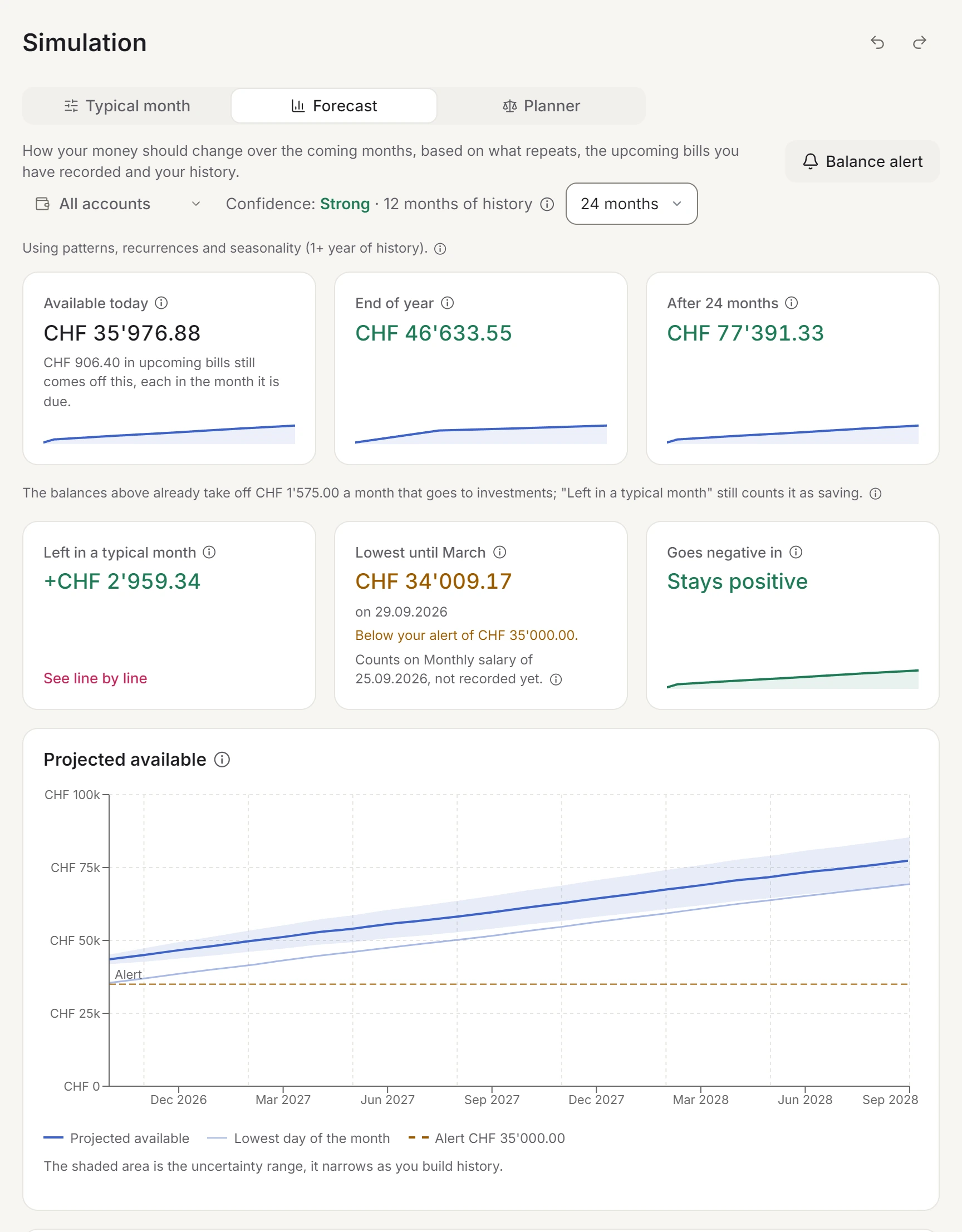
Record the provisional bill under To pay as soon as you know it, with its due date. The forecast puts the payment in that month, and Available on the dashboard counts it before any money leaves. If you pay in monthly instalments or by standing order, the app learns the repeating payment as a fixed expense and counts it ahead.
If you pay instalments, a budget that repeats once a year shows them against the year's amount and tells you whether you are ahead of pace. With a Balance alert, the app warns you months ahead when an account may fall below an amount you choose, the tax month included. You can look around the demo, with an example household and no account.
Questions about this page? Reach us any time and we'll walk you through it. info@spendhog.com