

There are three usual ways to fill a joint account: half each, in proportion to income, or everything into one pot. Add up what the account pays in a normal month, yearly bills included as a twelfth, split that sum the way you agree on, and keep a buffer, because the account is at its lowest right before the next transfer arrives.
01Half each, by income, or everything shared
Half each is the easiest to agree on. You add up the shared costs and each pays half. When your incomes are close, it is fair. When they are far apart, the one who earns less has much less left for everything else.
By income (pro rata) means each of you pays the same share of what you earn. If one earns 60% of the household's income, they pay 60% of the shared costs. Start from what each of you earns after tax.
Everything shared means both salaries go into the joint account, and each of you takes the same personal allowance out of it. It suits couples who see all their money as the household's. It needs the most trust and the most talking, because every purchase comes out of the same pot.
Many couples keep three accounts: one each and one together. That is the first two models, with the personal accounts holding what is not shared.
02The sums, worked in euros and in francs
An invented couple: Marta earns EUR 2,900 net a month and Jonas EUR 2,100, together 5,000. Their joint account pays the rent with service charges (1,500), groceries and household things (700), internet and phone (50), and two bills that are not monthly, as a monthly share each, and a holiday pot: electricity every three months (270, so 90 a month), the home insurance once a year (240, so 20 a month), and 140 a month for holidays together. That is EUR 2,500 a month.
Half each, both pay in 1,250. Marta keeps 1,650, which is 57% of her pay; Jonas keeps 850, which is 40% of his.
By income, Marta earns 58% of the 5,000 and pays 1,450; Jonas pays 1,050. Each keeps 50% of their pay: Marta 1,450, Jonas 1,050.
The same sums in francs, for an invented household in Switzerland: Noa earns CHF 6,200 net and Luca CHF 4,100, and their joint account needs CHF 3,535 a month. Half each, both pay in 1,767.50, and Noa keeps 71% of his pay while Luca keeps 57% of hers. By income, Noa pays 60.19% (2,127.87) and Luca 1,407.13, and each keeps 65.68%.
Both ways are fair if you both agree to them. Agreeing can take a whole evening. Write down what you chose, and look at it again when an income changes.
Half each
Marta, 2,900 netkeeps 57%
- Pays in 1,250
- Keeps 1,650
Jonas, 2,100 netkeeps 40%
- Pays in 1,250
- Keeps 850
By income
Marta, 2,900 netkeeps 50%
- Pays in 1,450
- Keeps 1,450
Jonas, 2,100 netkeeps 50%
- Pays in 1,050
- Keeps 1,050
Each bar is one net salary, drawn to the same scale. Half each, Jonas keeps a smaller share of his pay than Marta; by income, both keep the same share.
03What belongs on the joint account
What couples usually share: the rent with its service charges, energy, phone, internet and TV, household and liability insurance, media subscriptions, help in the house, and food, drinks and household goods. Costs for children you have together are shared too.
Add a monthly share of every shared bill that is not monthly, and anything you save for together, such as holidays. Leave out what each of you spends alone: clothes, hobbies, your own phone. That is what the money left on your own account is for.
If one of you works less to look after the home or the children, the split by income alone leaves that work out. Talk about it and agree how to count it, for example with a smaller share of the costs for the one who does more of the housework.
04What happens to the joint account during the month
The amounts above cover an average month. The account does not live an average month. Money comes in on two paydays and goes out on other days, and the bills that are not monthly come all at once.
Take Marta and Jonas, paying by income, in a March when the quarterly electricity and the yearly insurance both arrive. Marta is paid on the 25th, Jonas on the 5th, and the rent leaves on the 1st. The account starts at zero.
Bars left of the line are below zero: after the rent on 1 March, and again on 24 March, the day before Marta's pay.
| Day | What happens | Amount | Balance |
|---|---|---|---|
| 25 Feb | What happensMarta pays in | Amount+1,450.00 | Balance1,450.00 |
| 25 to 28 Feb | What happensGroceries | Amount-100.00 | Balance1,350.00 |
| 1 Mar | What happensRent | Amount-1,500.00 | Balance-150.00 |
| 1 to 4 Mar | What happensGroceries | Amount-90.00 | Balance-240.00 |
| 5 Mar | What happensJonas pays in | Amount+1,050.00 | Balance810.00 |
| 10 Mar | What happensInternet and phone | Amount-50.00 | Balance760.00 |
| 15 Mar | What happensElectricity for three months | Amount-270.00 | Balance490.00 |
| 20 Mar | What happensHome insurance for the year | Amount-240.00 | Balance250.00 |
| 5 to 24 Mar | What happensGroceries | Amount-510.00 | Balance-260.00 |
05What the month shows
The account went below zero twice, and neither time at the end of the month. The first was between the rent on the 1st and Jonas's money on the 5th. The second was on the 24th, the day before Marta's pay, after two bills that are not monthly landed in the same month.
Nobody paid in too little. Over the month 2,500 came in and 2,760 went out, because the electricity and the insurance took 510 at once while the monthly shares had put in only 110, and the 140 for holidays stayed in the account. In a calmer month the account gains, and over a year it evens out.
So the joint account needs a buffer: enough to cover the gap before the later payday, plus the worst month for the bills that are not monthly. Here that is at least EUR 260, and more in the first year, before the monthly shares have built up. The yearly bills planner works out the smallest amount to start the year with.
06When the joint account runs short before the end of the month
- Top it up once, split the same way as your monthly amounts. For Marta and Jonas, a shortfall of 260 is 150.80 from Marta and 109.20 from Jonas. The monthly amounts stay as they are.
- If it happens every month, the monthly amounts are too low. Add up the shared costs again, the bills that are not monthly included, and raise them.
- If it happens before one payday, both of you can pay in on the earlier one, or the one paid first can pay in a little more and the other a little less, as long as the month's totals stay the same.
- Avoid covering the gap with loans between the two of you. In a Mustachian Post article, the author describes doing that in the early years: it only added debt, and neither of them saw the household's money any more clearly (updated 3 December 2018).
- If you top up whenever the account runs low, look ahead. Knowing a week before that the account will not last is easier than finding out at the till.
07If you live in Switzerland
Budgetberatung Schweiz, the Swiss budget advice service, says unmarried couples usually split their shared costs by income (Merkblatt Konkubinat, 2025/2026). Its list of what couples share also names the radio and TV fee (Serafe).
Tax is usually not taken off the salary in Switzerland, so the consumer magazine Beobachter suggests working out each share from income after the tax owed. Each of you then sets your own tax aside every month.
For the housework, Budgetberatung Schweiz counts 1 to 1.5 hours a day per person and says the partner who does most of it is entitled to fair compensation, at CHF 30 an hour in its guidelines.
08Keeping an eye on the joint account with Spendhog
Some couples keep only the joint account in Spendhog and fill it from accounts the app never sees. Each top-up is recorded with the type Contribution, and From whom says who put it in. The app counts the usual level of your top-ups, the average of the last 6 months, and never treats them as a salary, so nothing is reported late when someone pays in a week later.
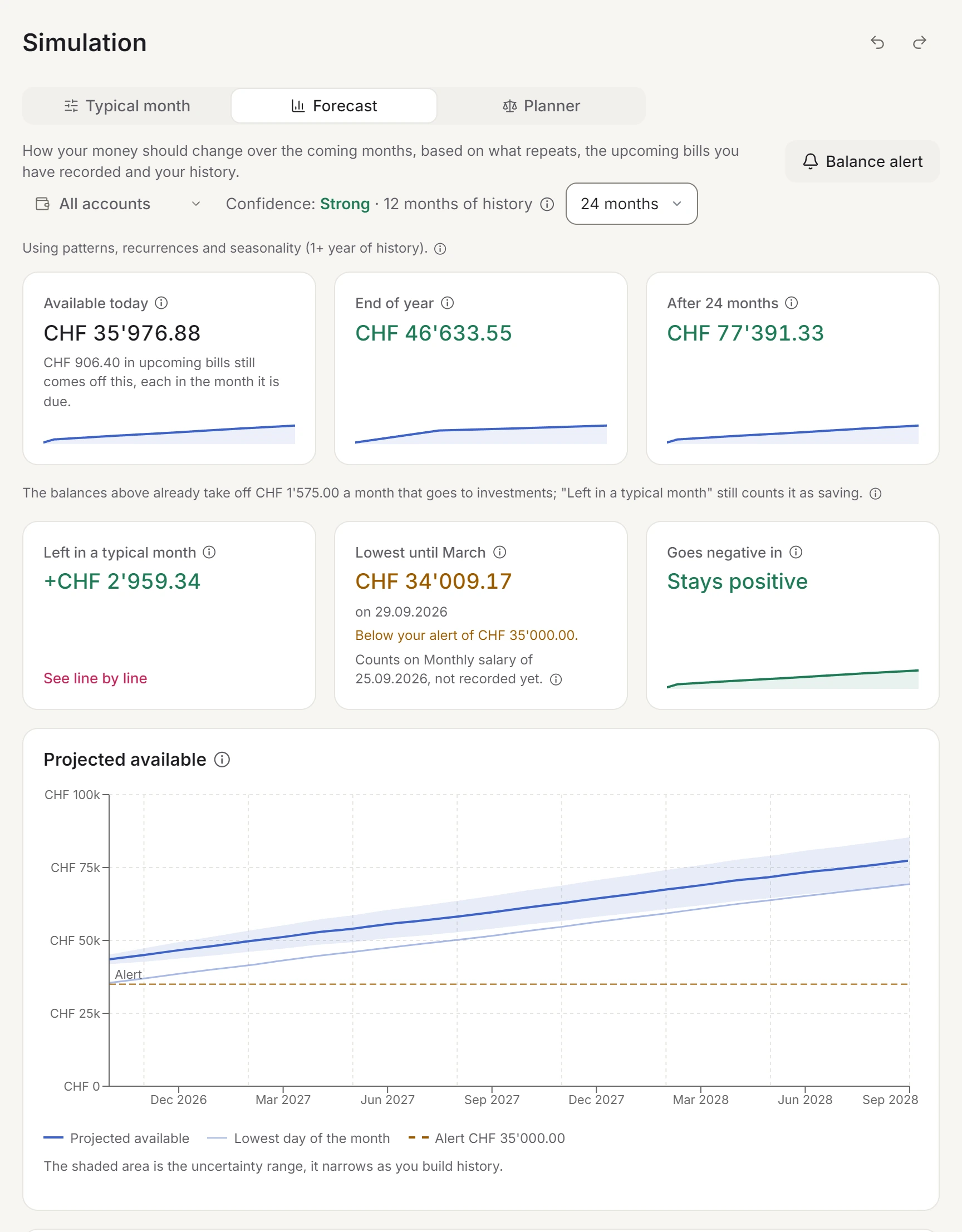
Once it has two complete months to learn from, the forecast can look at the joint account on its own and shows the lowest day of each month ahead. With a Balance alert you choose an amount the account should not fall below, and the app tells you which month may go under it first, while there is still time to top up.
Spendhog does not split bills or work out who owes whom; for that, a splitting app suits you better. You can look around the demo, with an example household and no account.
Questions about this page? Reach us any time and we'll walk you through it. info@spendhog.com