

Add up your yearly and quarterly bills, divide by twelve, and set that amount aside every month. This free Excel planner does the sums and shows you how much you need in the pot on 1 January so it never runs dry.
01Download the planner
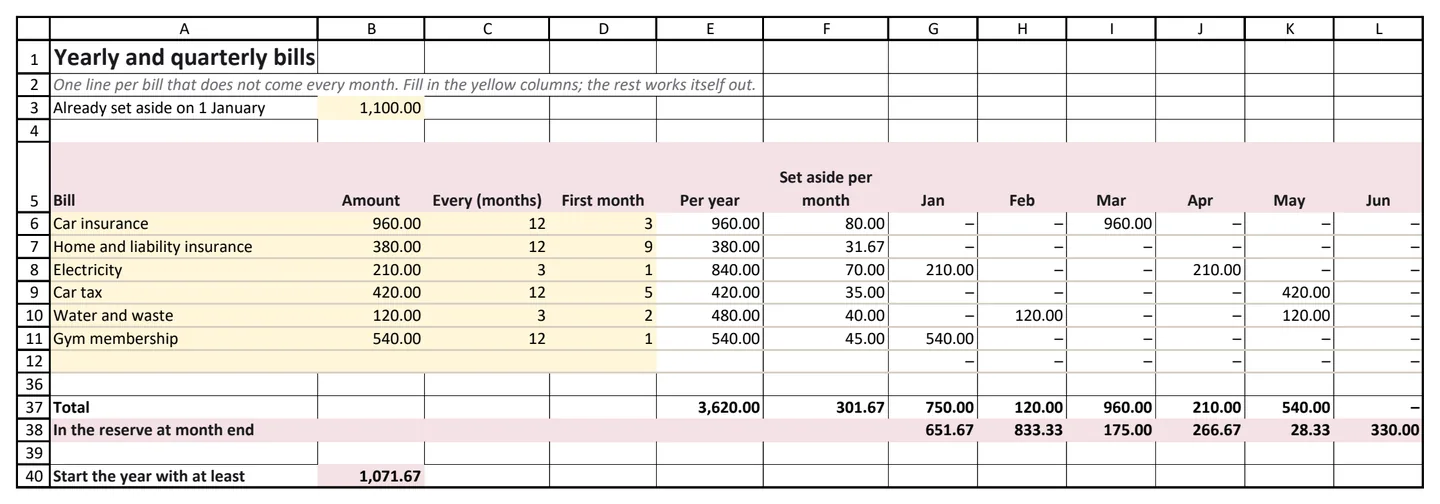
The planner is one Excel sheet. You write one line per bill that does not come every month: the amount, how often it comes, and the month of the first payment. The sheet works out what each bill costs a year, what to set aside each month, and a calendar of the months each bill falls due.
Below the calendar, one row shows what is left in your reserve at the end of each month. The last line tells you the smallest amount to start the year with, so the reserve never goes below zero.
The file opens in Excel, Numbers, LibreOffice and Google Sheets. The six bills in it are an example. Replace them with yours.
02What the example shows
The example has six bills: car insurance in March, home insurance in September, the car tax in May, a gym membership in January, and electricity and water every three months. Picture the car insurance arriving in March, a week after a weekend away. An account that looked fine in February is suddenly short, and the reserve is there for that month.
Together they cost 3,620 a year, so the sheet sets aside 301.67 a month. Most of the money goes out early in the year, though. By the end of May the bills have taken 1,071.67 more than the monthly amounts have put in. So the household needs to start the year with at least 1,071.67 in the reserve. After the first year the reserve refills itself, and the start amount is already there.

03How to make it work
- Look through last year's bank statements for every payment that came once, twice or four times. Most people find two or three bills they had forgotten.
- Keep the reserve in a separate account, so the money is not spent by accident. Move the monthly amount on the day your salary arrives.
- When a bill changes, change its line. The monthly amount follows.
- Leave out the bills that come every month. They belong in your monthly budget, like the one in our household budget template.
04How Spendhog handles bills that are not monthly
In Spendhog, a budget can repeat every 1, 2, 3, 6 or 12 months. A bill that comes every three months shows as on plan in the month it lands, because Spendhog compares your spending with how much of the period has passed.
Questions about this page? Reach us any time and we'll walk you through it. info@spendhog.com