

You make a household budget in four steps: write down your net income for twelve months, divide the fixed costs (yearly bills included) by twelve, set an amount for variable spending, and take the savings goal off at the start of the month. What is left is your buffer. If nothing is left, you find out now, while there is still time to cut somewhere.
01Step 1: Write down your income, twelve salaries
Write down what reaches the household's account each month, net. That is the salaries after deductions, plus any other regular income such as a pension or a side job. If your income varies, take the average of the last twelve months, even if your best month looks nicer.
If you are paid more than twelve times a year (a 13th-month salary, holiday pay, a Christmas bonus), leave the extra payments out of the month. Plan with twelve salaries. Decide in January what the extra money is for, for example part of it for the savings goal and part as a reserve for whatever breaks during the year.
You can also spread it over the year. Then you count one twelfth of it in each month, and the rest waits in a separate account. That takes discipline, because an account holding a double salary feels like more money than it is.
02Step 2: Fixed costs, including the yearly bills
Fixed costs are everything you do not decide again every week. What comes once a year or every three months, you divide by twelve. You set that amount aside every month, even if the bill only arrives in autumn. Otherwise two or three of these bills land in the same month, and the account that always seemed to be enough is suddenly empty. Our yearly bills planner for Excel works out the monthly amount and the month each bill falls due.
Rent, with the advance payment for service charges. Where a yearly service charge statement arrives, it can bring a back payment, so keep a little aside for it.
Electricity and heating, phone and internet, home contents and liability insurance, and the passes for public transport. With a car, add its insurance, the vehicle tax and servicing, also divided by twelve.
Taxes and health insurance are taken off the pay in many countries. Where they are not (in Switzerland, or if you are self-employed), they arrive as bills and are fixed costs too: put a twelfth aside every month. The section on Switzerland below shows how.

03Step 3: Variable spending, with one amount per category
Groceries, household, clothes, the hairdresser, leisure, restaurants, gifts: you decide these afresh every week. So each category needs an amount you can measure yourself against.
For the amounts, take the last two or three months. Go through the bank statement, sort the spending roughly into categories and take the average. Your own history is a better starting value than any table of averages.
As a couple, it is worth setting an amount for personal spending per person. With an amount of your own, you do not have to justify every coffee.
Plan provisions for the irregular as well, for example for the dentist, glasses, gifts and holidays.
04Step 4: Take the savings goal off first
Set a fixed amount. Transfer it by standing order the day after your salary arrives, to a separate account. You live on the rest day to day.
Give the goal an amount and a date. 9,000 for a car in a year and a half is 500 a month. If the money does not stretch that far, move the date or lower the amount. That is easiest now, while it is still a number on paper.
For a move, the removal company is often the smaller part. The new deposit can be several months' rent, and it often goes out before the old one comes back.
05An example: a month's budget for two adults
An invented household in Germany: two adults, renting, no car. The amounts are round numbers and our own sums. Tax and health insurance are already taken off their pay. Your rent and your prices will look different, but you calculate the same way.
- Income: EUR 2,300 and EUR 1,700 net, together 4,000 a month, twelve times a year.
- Rent with service charges: 1,100. Electricity, internet and phone 190, local transport 130, home contents and liability insurance 60. Fixed costs together: 1,480.
- Variable spending: groceries and household 500, personal spending 250 per person, shared leisure and restaurants 300. Together 1,300.
- Provisions: dentist and glasses 50, gifts 120, holidays 300, the unexpected 100. Together 570.
- Savings goal: 500 by standing order at the start of the month.
- That leaves a buffer of EUR 150 a month, deliberately not planned.
- A Christmas bonus or holiday pay, if one of them gets it, goes to the savings goal and the reserve in the month it arrives, and no month runs short because of it.
06Three common mistakes
- Forgetting the yearly bills. Car and home insurance, the service charge statement, yearly subscriptions and, where you pay them yourself, taxes do not come every month. If you do not set them aside monthly, there will be months when nothing adds up.
- Counting an extra salary in the month, or spending it in December. It is part of your yearly pay that arrives later.
- Treating irregular costs as the exception. The dentist, gifts or a bike that needs repairing rarely come one at a time, but over a year they are certain. Give them a provision and look at the whole year.
07If you live in Switzerland
Four things change the sums. Leave the 13th-month salary out of the month: Budgetberatung Schweiz, the Swiss budget advice service, also works with net income without it in its budget examples (version 2025/2026). As a guide for rent it gives about a quarter of net income, up to a third with service charges.
Health insurance is a bill of its own. According to the Federal Office of Public Health (BAG), the average adult premium rises to CHF 487.60 a month in 2027 (announcement of 29 September 2026). Your premium depends on your canton, your deductible and your model; priminfo.admin.ch shows it. Set a little aside for the deductible and the co-payment as well.
The Serafe radio and television fee costs CHF 335 per private household in 2026 and CHF 312 from 1 January 2027 (serafe.ch, as of October 2026), normally billed once a year: CHF 26 a month in a 2027 budget.
For most households taxes are not deducted from the salary (tax at source is the exception). Take your last final tax bill, divide it by twelve and set that aside, or pay the tax office by standing order. Budgetberatung Schweiz calls the idea that the 13th-month salary covers the taxes a false assumption. Paying early often pays off: the canton of Aargau pays 0.25 percent interest for tax year 2026 on payments before 31 October and charges 4.5 percent late-payment interest after the due date. For a car, the TCS puts its model car (CHF 45,000 new, 15,000 km a year) at about CHF 926 a month in 2026.
The same method for an invented Swiss household in 2027: two adults, renting, no car, amounts rounded, the source named where a figure has one.
- Income: CHF 4,600 and CHF 3,400 net, together 8,000 a month, without the 13th-month salary.
- Fixed costs 4,251: rent with service charges 2,000 (a quarter of net income, Budgetberatung's guide value), basic health insurance for both 975 (the BAG average of 487.60 per person, no premium reduction), Serafe 26, taxes 700 (Budgetberatung's couple example with CHF 8,000 net works with about 670 at an average tax rate, version 2025/2026), contents and liability insurance 50, electricity 80, phone and internet 120, public transport passes for both 300.
- Variable spending 1,750: groceries and household 900, personal spending 300 per person, shared leisure and restaurants 250.
- Provisions 750: deductible and dentist 150, gifts 100, holidays 300, the unexpected 200.
- Savings goal 1,000, which leaves a buffer of CHF 249 a month.
- The 13th-month salary, here around CHF 8,000 net, is assigned in January: half to the savings goal, half to the reserve. That puts CHF 16,000 a year into the savings account.
08Spreadsheet or app?
For planning, a spreadsheet or a sheet of paper is enough. Our household budget template for Excel is a good start.
What comes after is harder. You only see whether your plan holds when you record what you spend. That is what a household spending log is for. How to keep one without much effort is in the guide on how to track household spending.
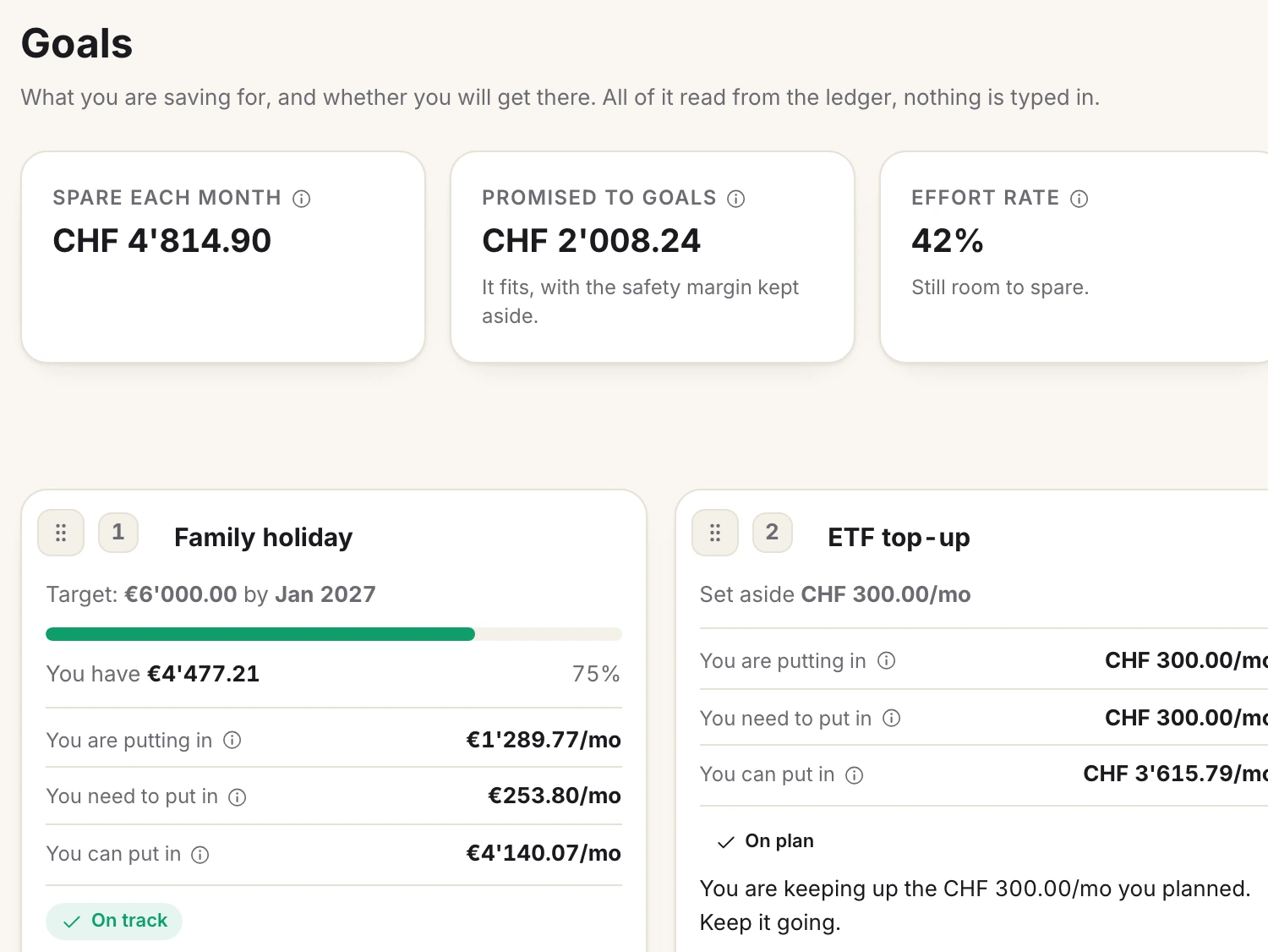
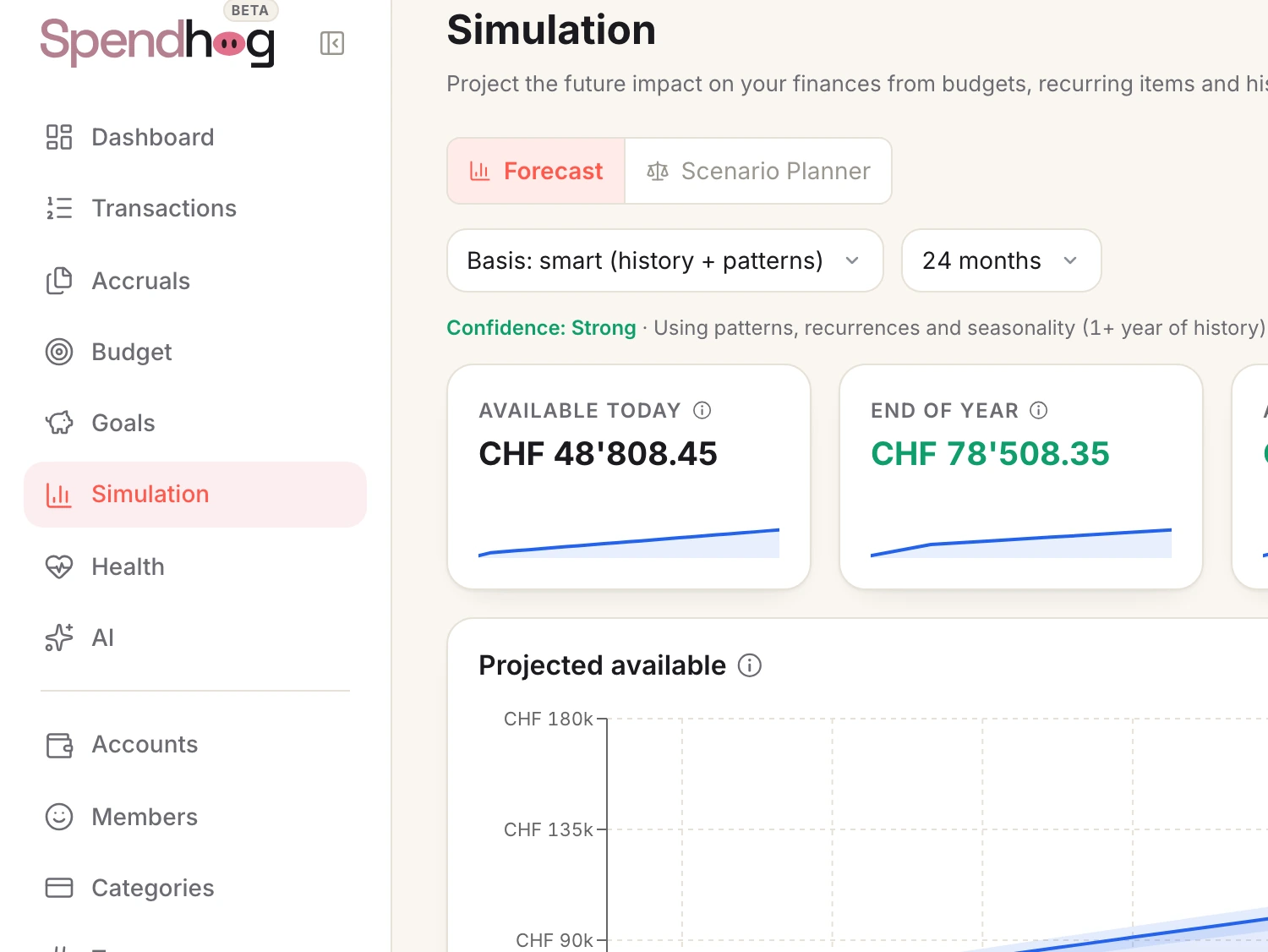
An app takes the sums off your hands, though not the entering. In Spendhog you spread a yearly bill over the budget with the field "Spread over (months)", and the payment stays on its day. Budgets compare your spending with how much of the period has already passed. The forecast spreads the yearly bills over the year. A goal reads the real balance of the account it is attached to.
You make the entries yourself, by hand or by importing your bank's export (CSV, camt.053, OFX or MT940). There is deliberately no bank connection. Spendhog does not work out your taxes: you get that amount from the tax office.
If you already know you will not record anything, use a spreadsheet and adjust it once a year. You can try Spendhog free for 30 days, with no card and no bank login. After that it costs CHF 8.99 a month. That is the founder price for the first 30 households that take out a subscription, and it stays as long as the subscription runs.
Questions about this page? Reach us any time and we'll walk you through it. info@spendhog.com